
Lakeland Slip and Fall Lawyer
 A fall in a local grocery aisle or apartment stairwell can leave you with medical bills, missed work, and a manager who seems more worried about liability than about you.
Florida law gives injured people a way to hold a careless business accountable, but it also sets a specific proof rule, a two-year filing deadline, and a cutoff for shared fault. A Lakeland slip and fall lawyer can explain how each one applies while evidence like store video still exists.
Smith, Feddeler & Smith, P.A. has an office right here in Lakeland, on Florida Avenue South. Call (863) 355-4204 or contact us to schedule a free case evaluation, where you speak directly with one of our attorneys.
Why Lakeland Fall Victims Choose Smith, Feddeler & Smith, P.A.
 A slip and fall claim often depends on proving how long a hazard sat on the floor, and that kind of proof takes patience to build.
With over 50 years of combined experience among our attorneys, we stay with a case until it is resolved rather than rushing it toward an early, low settlement.
That staying power matters in a fall case, where the business may argue it had no way of knowing about the hazard. Insurers know we are willing to take that argument all the way to trial in front of a Polk County jury, and that gives us real leverage when it is time to negotiate.
What Counts as a Slip and Fall Claim in Florida?
A slip and fall claim is a type of premises liability case, meaning a claim that a property owner or business failed to keep its property reasonably safe. It is a form of negligence, the legal term for failing to use reasonable care. Falling on someone else’s property does not by itself make the owner responsible. A fall generally becomes a claim when:
- A dangerous condition, such as a spill, a loose mat, or a broken step, was on someone else’s property
- The owner or business knew about it, or should have known, and did not fix it or warn about it in time
- That condition caused the fall
- The fall caused an injury with real losses, such as medical bills or missed work
Falls like these often happen in grocery stores, big-box stores, restaurants, and apartment or condo common areas, including at the retail plazas along the US-98 and Memorial Boulevard corridors. The setting shapes what evidence exists. A grocery store usually has security cameras and incident-report forms, while an apartment complex may rely more on maintenance logs and resident complaints.
What Do I Have to Prove After a Slip and Fall in a Lakeland Store?
When a fall inside a business is caused by a “transitory foreign substance,” the legal term for something temporary on the floor such as a spilled drink, dropped produce, or tracked-in rainwater, Florida’s slip and fall statute requires the injured person to prove that the business had actual or constructive knowledge of the dangerous condition and should have taken action to fix it.
| Type of knowledge | What it means | Common example |
| Actual knowledge | An employee saw the hazard, was told about it, or created it | A worker mops an aisle and puts out no wet-floor sign |
| Constructive knowledge | The hazard existed long enough that ordinary care should have caught it, or it happened so regularly that it was foreseeable | A cooler that leaks onto the same spot of floor week after week |
Constructive knowledge is often the harder one to prove, because it depends on indirect evidence rather than a witness. Picture a spilled drink in a grocery aisle with shopping-cart tracks running through it and footprints leading away. Those tracks can be circumstantial evidence that the spill sat there long enough for staff to notice it.
The statute also leaves in place any broader duty of care the business already owed under Florida common law, meaning the rules courts have built up through past decisions.
What Should I Do Immediately After a Fall in Lakeland?
The first hours after a fall are when the most useful evidence is easiest to gather, even though they are also when you are hurting and shaken. These steps tend to preserve it before it disappears:
- Reporting the fall: Telling a manager before leaving and asking for a copy of any written incident report creates a record that the fall happened on the property.
- Photographing the scene: Photos of the hazard and the area around it, including cart tracks, footprints, or a missing warning sign, can help show how long the hazard had been there.
- Identifying witnesses: Names and phone numbers are much harder to track down once people leave.
- Getting medical care: A same-day medical visit, even for an injury that seems minor, ties the injury to the fall in the medical records.
- Preserving video: Surveillance footage may be recorded over if no one asks the business to keep it, so a written request to preserve it is worth sending early.
How Long Do I Have to File a Slip and Fall Lawsuit in Florida?
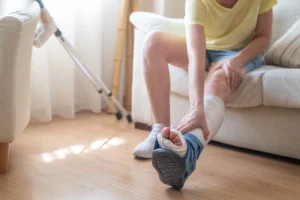 For most falls, Florida’s statute of limitations, the legal time limit for filing suit, allows two years to file a negligence lawsuit under Section 95.11 of the Florida Statutes.
The clock starts when the claim accrues, meaning when the last legal requirement for the claim is in place. For a fall that causes an injury, that is usually the day of the fall itself.
A lawsuit filed after the deadline can be dismissed no matter how strong the facts are. A lawsuit over a fall in Lakeland would generally be filed in Polk County, which is part of Florida’s Tenth Judicial Circuit. Starting early leaves more time to collect video, find witnesses, and gather medical records while they are still available.
What If I Was Partly at Fault for My Fall?
Florida uses modified comparative fault, a rule that lets a jury split the blame between the injured person and the business. Under Florida’s comparative fault law, a person’s damages shrink by their own share of fault, but a person found more than 50% at fault for their own harm recovers nothing. A business or its insurer may argue the injured person shares the blame because of things like:
- Looking at a phone instead of where they were walking
- Walking past a wet-floor sign or through a coned-off area
- Going into a stockroom or other area closed to customers
As an illustration, suppose a shopper looking at a phone slipped on a freshly mopped floor with no warning sign posted. The missing sign points to the store, while the phone points to the shopper. If a jury valued the claim at $50,000 and found the shopper 20% at fault, the recovery would be $40,000. At 51% fault, it would be nothing.
What Compensation Can I Recover for a Slip and Fall Injury?
Depending on the injury, a successful slip and fall claim can include compensation for:
- Medical care: Emergency treatment, surgery, physical therapy, and future care tied to the fall.
- Lost income: Wages missed during recovery and any reduced ability to earn later.
- Pain and suffering: Physical pain and the ways the injury limits daily life, family time, and favorite activities.
Medical bills and lost income are economic damages, meaning losses with a dollar figure attached. Pain and suffering is a form of noneconomic damages, which covers losses that are real but harder to put a price on.
What to Expect in a Lakeland Slip and Fall Case
A premises liability claim generally moves through these stages:
- Case evaluation: An attorney reviews how the fall happened, the injuries, and the filing deadline.
- Evidence gathering: Requests to preserve video, incident reports, and maintenance logs, along with medical records.
- Insurance claim: A demand to the business’s insurer once the full extent of the injuries is clear.
- Negotiation or lawsuit: Settlement talks, or a lawsuit filed in time if the insurer will not pay fairly.
Frequently Asked Questions About Lakeland Slip and Fall Claims
What If I Slipped and Fell at Work in Lakeland?
A fall on the job, such as in a warehouse, on a construction site, or in a hospital, is usually covered by Florida workers’ compensation, which pays for medical care and part of lost wages without anyone having to prove fault.
If someone other than the employer controlled the property, such as a building owner or another contractor, there may also be a separate premises liability claim against that party. Because we handle workers’ compensation claims in Lakeland as well as personal injury cases, both paths can be reviewed at the same time.
What If the Store Says It Checked the Floor Before I Fell?
That claim matters, because inspection records go straight to constructive knowledge, the “should have known” part of the proof rule. A sweep log showing an employee checked the aisle a few minutes before the fall may help the business argue the spill was too new for anyone to notice. A log with long gaps, or no log at all, can support the argument that the hazard sat long enough to be found with ordinary care. That is one reason the business’s own records are worth requesting early.
Can I Still Bring a Claim If I Did Not Report the Fall Right Away?
A late report does not automatically end a claim, but it can make the claim harder to prove. The business may argue the fall happened somewhere else or that the injury came from another cause. Medical records, photos, a receipt showing you were in the store that day, and witness statements can help fill that gap.
Bring Your Questions to a Lakeland Slip and Fall Lawyer
Healing from a fall is hard enough without arguing with an insurer about who should have cleaned up the floor. Smith, Feddeler & Smith, P.A. can walk through how the proof rule and filing deadline apply to your fall and help you decide on next steps.
Call our Lakeland office at (863) 355-4204 or contact us today to schedule a free case evaluation with a Lakeland slip and fall lawyer.





Phone calls were returned timely. I was kept informed of my case and my questions were answered. The staff was professional, courteous, concerned and caring. Overall my experience with this law firm was good and I would recommend them to a friend.
- Rhonda D.
Keep up the good work!
- Thomas B.Everyone who I had the pleasure in talking to or email correspondence has been great and professional. Thank you all for the good service.
- Elixsandra F.Everyone in the office was always helpful and did everything to help up on the case.
- Thomas D.I appreciate all the work you all did. I will recommended Brad Smith and Smith, Feddeler & Smith to anyone who is looking for good legal help.
- Robert S.I would like to thank Mr. Feddeler and the Law Firm for their help in my workers; compensation case. I want to especially thank Julie for being such a special lady and for have such a patient and wonderful personality and manners. She kept me informed of what was going on and answered all my questions when I needed them.
- Stanley E.I am thankful with the firm and staff for always being so courteous and helpful with my case and with me. You guys helped me every step of the way and I am glad I chose your firm to represent me. Thank you for all you do!
- A Montalvo.Everyone that was involved with my case was awesome! No complaints. Hope I never need to get a lawyer again, but if I did I would choose this Law Firm. So thank you!
- Juanita B.I was bit by a Pit Bull in the face in May of 2016. The injuries I suffered was a fractures nose and teeth marks to the nose and under my lip. I chose Smith, Feddeler because they had a great reputation on line. They were very compassionate, very sympathetic and very respectful of the situation I was going through. The attorney was very sincere and staff always responsive and available when I needed. I would definitely recommend Smith, Feddeler & Smith. Kevin Balentine was very helpful and efficient.
- Lauren M.If you ever want a good attorney who is going to fight and advocate for injured workers and knows the law of workers’ comp in the State of Florida, please contact Brad at Smith, Feddeler & Smith. I assure you they will fight for your rights and you will come out victorious, and you will be able to tell somebody else like I’m telling you.
- Ricky B.Contact Us For A Free Consultation With A Qualified Lawyer